
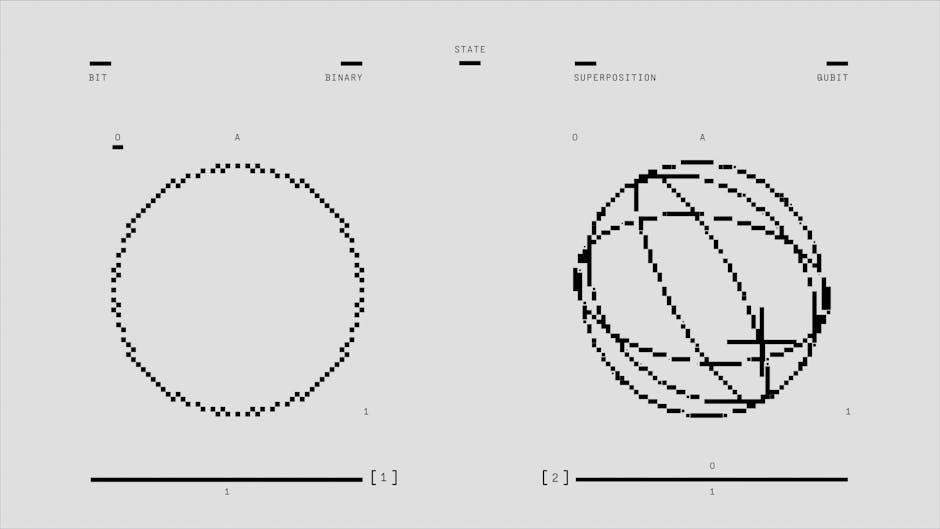
Understanding Quantum Superposition: The Key to Quantum Computing
Quantum superposition is a fundamental principle of quantum mechanics that allows particles to exist in multiple states at the same time. Unlike classical objects, which are in a definite state, particles such as electrons or photons can be in a combination of states until measured.
This phenomenon is essential for the development of quantum computing, enabling qubits to perform complex calculations more efficiently than traditional bits. By leveraging superposition, quantum computers can explore numerous solutions simultaneously, offering unprecedented processing power.
Understanding how quantum mechanics explains superposition helps scientists harness this property for practical applications, including cryptography, simulation of molecular structures, and solving optimization problems.
Practical Implications of Quantum Superposition
Researchers are actively exploring ways to maintain and manipulate superposition states within quantum systems. Challenges such as decoherence need to be addressed to build reliable quantum devices. As technology advances, the potential for quantum superposition to revolutionize fields like cryptography and material science grows exponentially.
For a deeper understanding of how superposition interacts with other quantum phenomena, check out our guide on entanglement and superposition.